Available Pumps, wells and reservoirs operations

Control

Full control over the operation of pumps, wells and reservoirs - in real time, from the desk instead of the field.

Control replaces paper operating logs and scattered spreadsheets with a single application: it monitors operating parameters, collects alarms from every facility, lets you switch pumps on and off remotely, and sizes the pump for the well. Everything in the browser, with a map, charts and history.
+48 505 901 805
Control - operational dashboard with a facility map

Three problems we solve

We know them from daily work with pumps and deep wells.

Scattered facility data

Well parameters in binders, measurements in spreadsheets, failures in notes. Control gathers records, measurements, alarms and documentation in one place - every piece of information tied to a specific facility.

No live control over pumps

Without continuous insight into operating parameters, a failure only comes to light after the fact. Control shows the status of pumps, wells and reservoirs in real time and raises alarms before a shutdown occurs.

Paper operating documentation

Hand-kept logbooks get lost and provide no analysis. Control keeps a digital operating logbook with history and trends - data instead of paper, ready for reporting and audits.

Who Control is for

Operation departments

Teams responsible for the day-to-day operation of deep-well pumps in water and wastewater utilities and in enterprises with their own intakes - needing monitoring of technical condition and notifications of anomalies.

Technical managers

People responsible for energy optimization, reliability and infrastructure maintenance costs - needing analysis of operational parameters and operational reports.

Service teams and designers

Service departments handling requests and failure history, and designers sizing pumping units - needing a single tool that combines operational data, diagnostics and pump sizing.

What Control can do

One environment for the entire operation - from a measurement at the well to sizing a new pump.

Remote pump control

Switching a well pump on and off remotely - the command reaches the facility controller, and every instruction is saved in the history (signal type, time, user). React without driving to the field.

Central alarm registry

All events from all facilities in one place: dry running, no power, motor temperature, vibration, leakage, level exceedances. Handling statuses: new, acknowledged, resolved.

Dashboard and facility map

How many wells are running, how many are off, how many alarms - on a single screen. An interactive map with wells and reservoirs, status and energy colours, and grouping by intake.

Operational measurements

A digital operating logbook: flow rate, static and dynamic levels, pressures, current, voltage and power draw - with date, author and full history. Hydraulic, electrical and chemical parameters in one place.

Pump diagnostics

The actual operating point overlaid on the pump's flow, power and efficiency curves. The system assesses whether the pump runs in its optimal range, detects deviations and generates service recommendations.

Reservoir monitoring

Level and fill percentage, inflow and outflow balance, temperature and treated-water parameters (chlorine, turbidity, pH), with automatic recalculation of the current volume. Control of reserves and safety.

Pump sizing

An engineering calculator selects the pump class, number of stages, motor power, installation depth and start-up method - with operational warnings. AI reads the parameters from documents, while a repeatable algorithm computes the sizing.

Energy and cost analysis

Energy consumption, cost in PLN and unit energy intensity per cubic metre (kWh/m³, PLN/m³), with a ranking of the most energy-hungry facilities. A direct pointer to where savings can be found.

Water quality control

A registry of physicochemical results (pH, turbidity, hardness, iron, manganese, nitrates and others) with automatic detection of standard exceedances and a sample compliance indicator. Health safety under control.

Why Control

What sets Control apart from spreadsheets and scattered tools.

Control with a full audit log

Switch pumps on and off remotely, with every command recorded together with its time, source and author. A fast reaction without driving to the field - and full accountability.

AI reads, the algorithm computes

Artificial intelligence reads parameters from documents, including scans, but the pump sizing itself is computed by a repeatable, auditable engineering algorithm - not guessed. Reliability and professional accountability.

Data protection in AI

Before documents are sent for analysis, personal data and identifiers (names, licence numbers, phone numbers, addresses) are masked. Only the technical parameters needed for sizing reach the service.

Multi-tenancy

A single installation serves many organizations or branches in separated data spaces. Ideal for capital groups and companies managing multiple entities.

What it looks like in action

Four views from the application - from the operational dashboard to a well diagram with control.

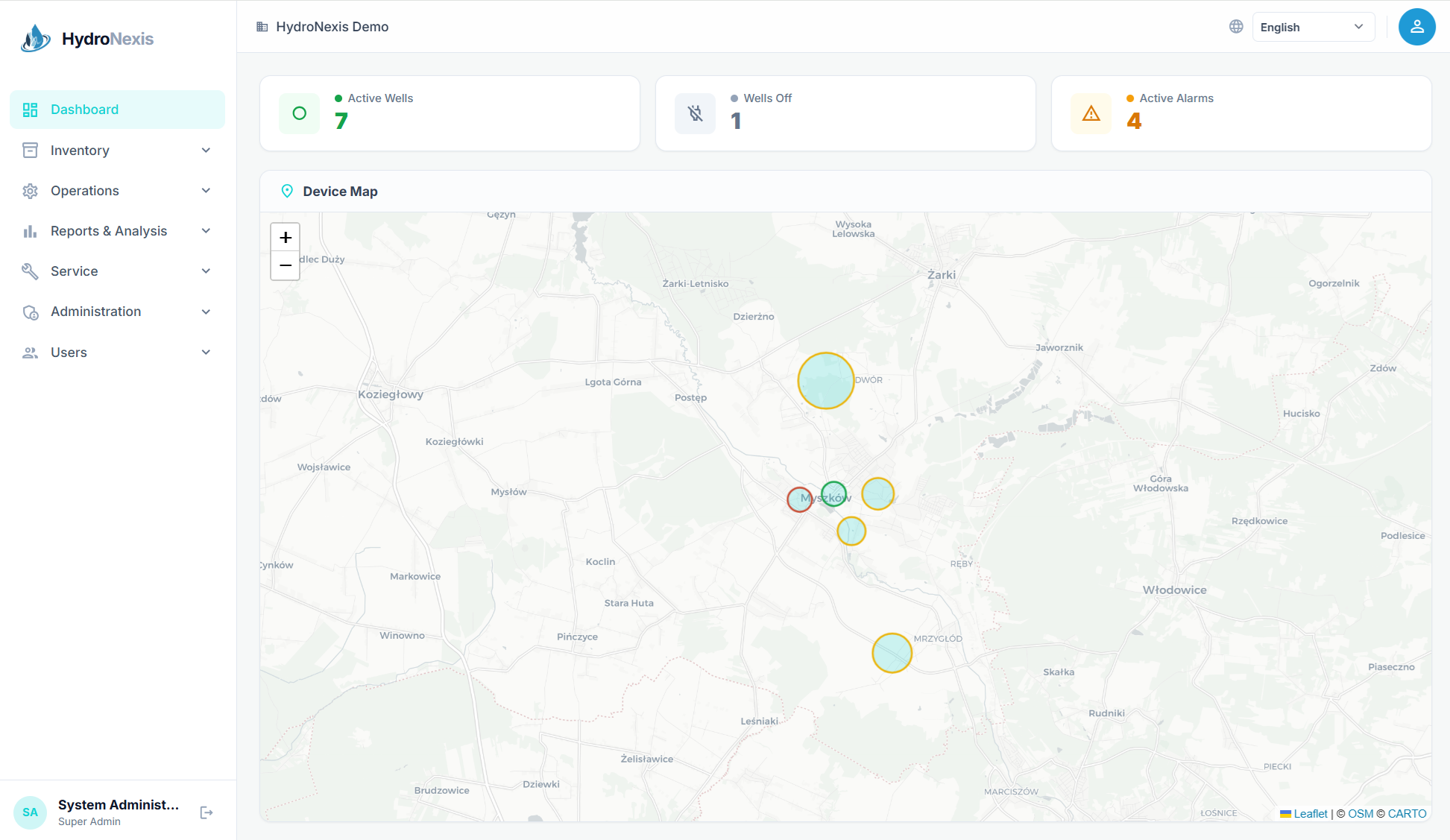
Control - operational dashboard with a facility map
Operational dashboard

Number of active wells, disabled devices and active alarms. A facility location map with status markers - the full picture of the infrastructure in one view.

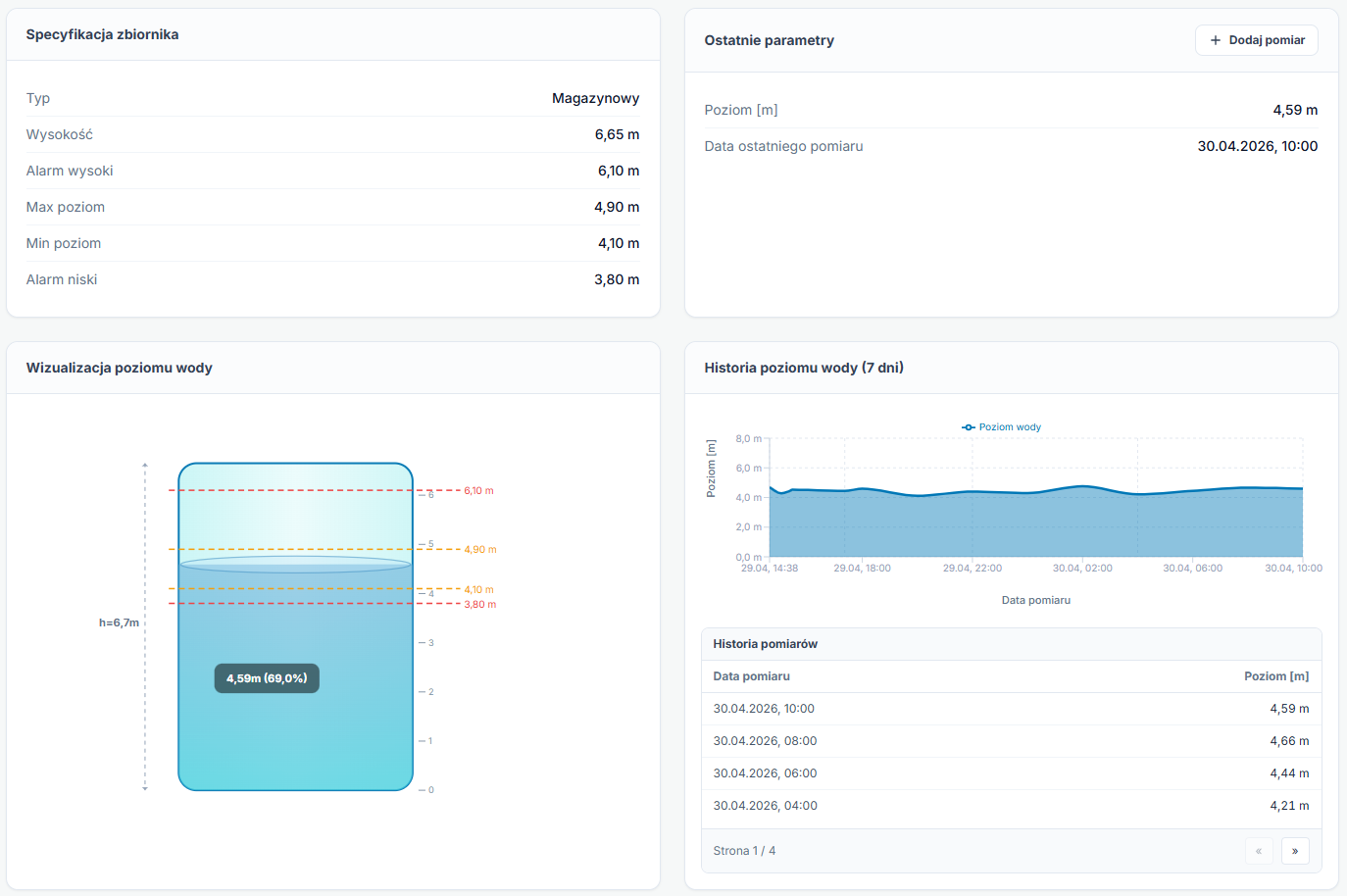
Control - reservoir visualization
Reservoir visualization

Reservoir specifications, high and low level alarms, a graphical fill visualization, a 7-day level history chart and a measurement table.

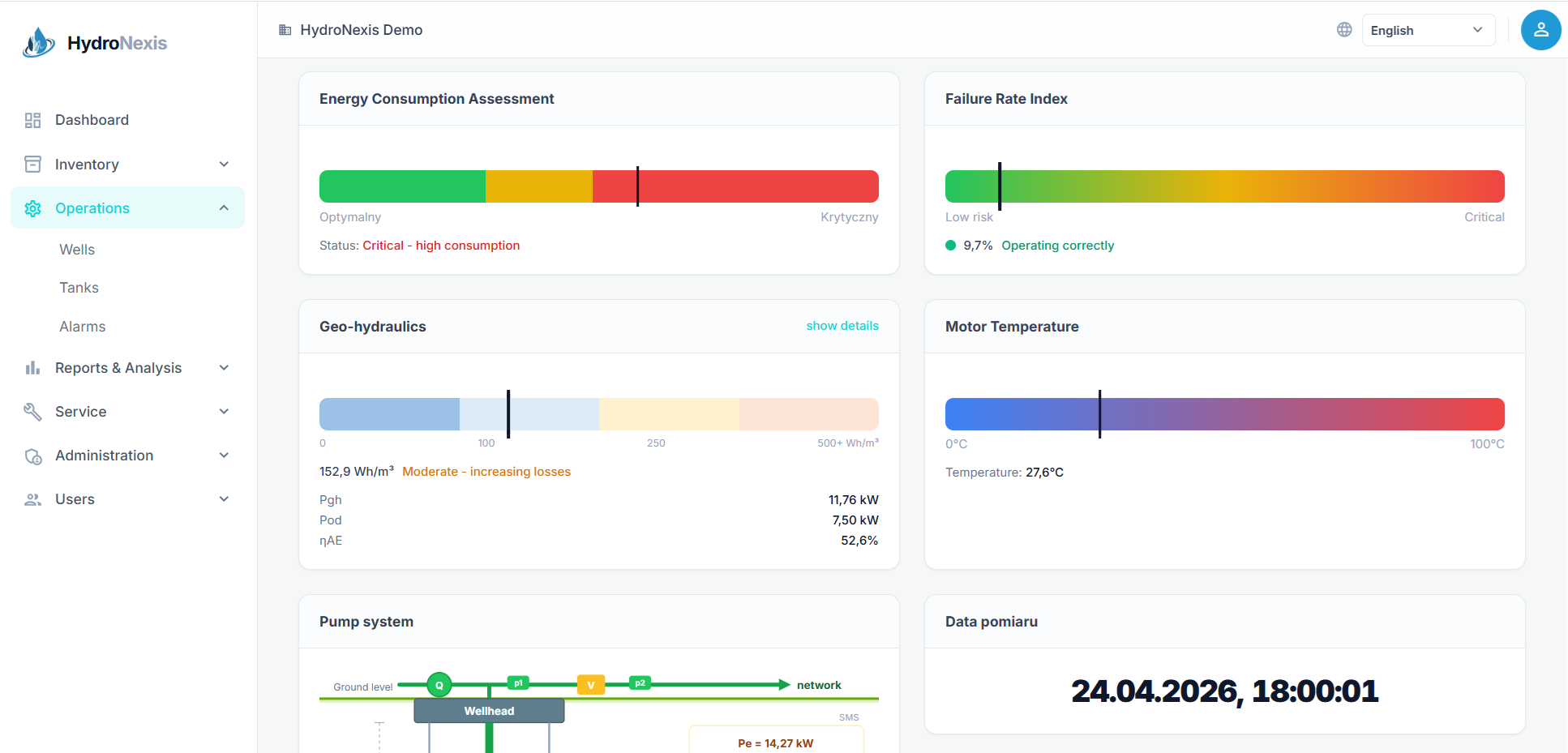
Control - operational pump diagnostics
Pump diagnostics

Visual indicators of the pump's technical condition: energy efficiency, risk of failure, geo-hydraulic parameters, motor temperature. Alarm zones with immediate assessment.

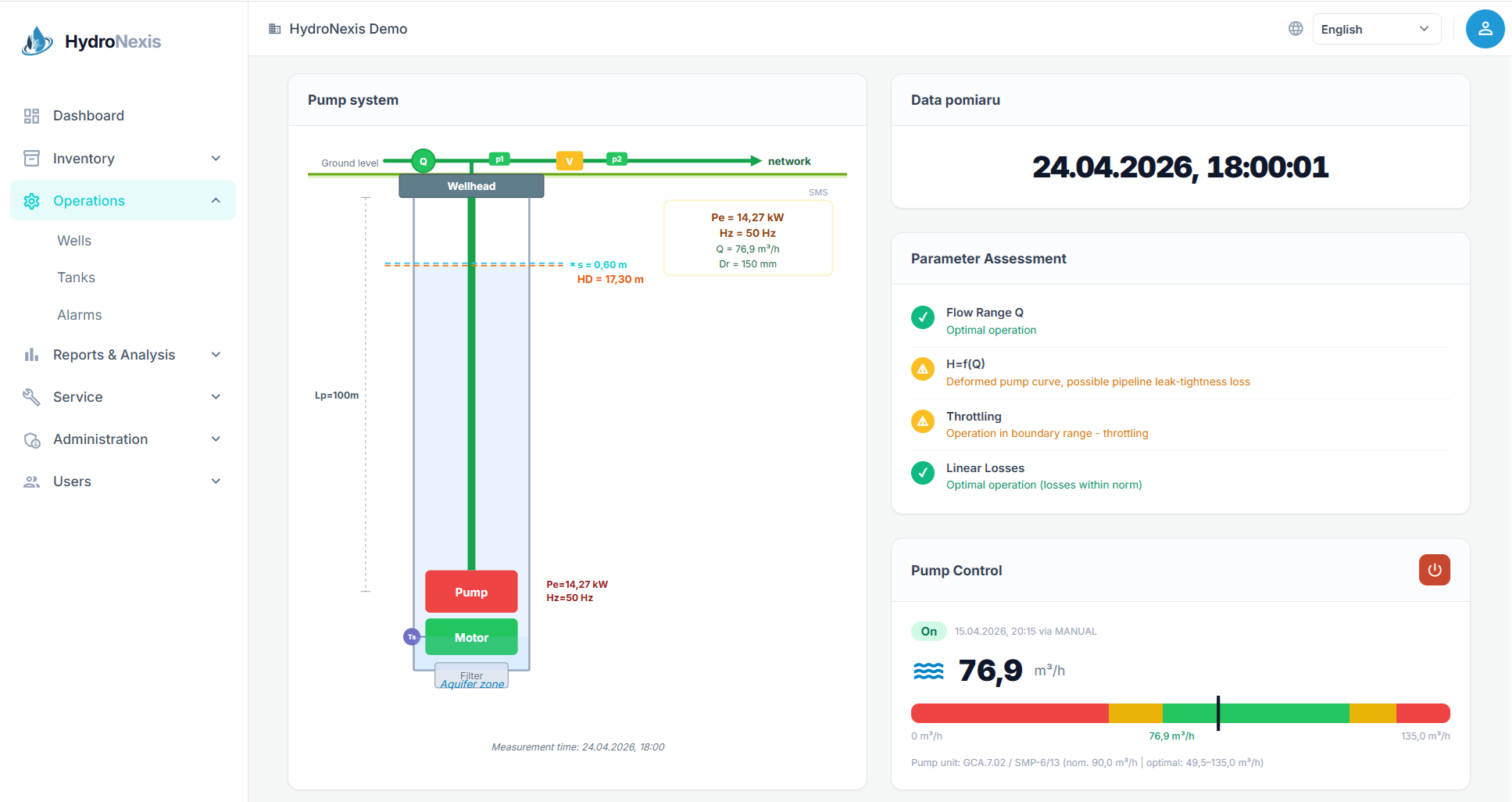
Control - well diagram and pump control
Well diagram and control

A full diagram of a deep well with operating parameters, an assessment of the pump condition against its characteristics, and remote control of pump operation with operation history.

Integrations and measurement layer

Control receives data from the measurement infrastructure and integrates with the other HydroNexis modules.

WMS

Cooperation with the WMS module in the HydroNexis ecosystem - the well passport from WMS supplemented with operational data and measurements from Control. We determine the scope of integration during implementation.

SMS gateway and control

Sending control commands to the well via HTTPS integration with an SMS gateway. Every control action is saved in the signal history together with its time and author.

Document reading (AI/OCR)

Automatic reading of parameters from surveys, designs and specifications for pump sizing - including from scans, thanks to text recognition (OCR). Personal data is masked before sending.

E-mail notifications

Notifications of alarms and operational events via SMTP, in accordance with a configurable policy for each organization. Export of data and reports to PDF and Excel.

Proven measurement layer

We provide our implementations with a complete stack: the Control application plus a measurement layer and telemetry gateways from Polish manufacturers with whom we cooperate operationally. The client receives one coherent system - with no need to coordinate several suppliers separately.

Probes and measurement transmitters

Industrial-grade depth probes, pressure transmitters, temperature and flow sensors supplied by Aplisens S.A. - a Polish manufacturer of measurement and control equipment and a European market leader in this category.

Controllers and data transmission

Telemetry controllers (including SMART-500 and HydroCTRL AI) and transmission gateways supplied by Polish providers with over 35 years of experience in automation and telemetry. Communication via RS-232, RS-485, M-Bus and GSM, LTE-M wireless transmission.

The brands mentioned are trademarks of their respective owners. Operational cooperation covers implementations for shared clients.

What your team gains

Time savings

Remote control instead of field trips, and AI fills in sizing parameters from documents. Less manual work, a faster reaction.

Safety and continuity

A central alarm registry and roles with granular permissions give you control over the continuity of water supply.

Energy cost control

Energy intensity in kWh/m³ and cost in PLN/m³ together with a facility ranking show where energy is being lost.

Data-driven decisions

Operational and historical reports together with trends turn raw measurements into ready analyses and conclusions.

Frequently Asked Questions

The system is ready for immediate use. After you request a demo and we agree on the scope of cooperation, we activate your organization's account within 1-3 business days. The scope of historical data import and integration with your existing measurement infrastructure is determined individually - typically 1-3 weeks of work depending on the scale of the infrastructure.

Yes. Control and WMS are two modules of the HydroNexis ecosystem and work together - the well passport from WMS can be supplemented with operational data and measurements from Control. We determine the specific scope of integration during implementation. Each module can also work independently.

Pump sizing is handled by an engineering calculator which, based on well parameters and system requirements, selects the pump class, number of stages, motor power and installation depth and recommends the start-up method (direct-on-line, soft start, variable-frequency drive), together with operational warnings. Artificial intelligence plays a purely supporting role here: it reads parameters from the uploaded documentation (surveys, designs, specifications, including scans) and pre-fills the form, marking the source and confidence level of each value. The sizing result itself is computed by a repeatable, auditable algorithm - it is not guessed by AI. Before documents are sent for analysis, personal data and identifiers are masked.

In our implementations, we standardly provide a complete measurement stack: depth probes, pressure transmitters, temperature and flow sensors from the Polish manufacturer Aplisens S.A. and telemetry controllers (including SMART-500) from the Polish company Control Sp. z o.o. (control.com.pl). The controllers communicate with the measuring devices via standard industrial protocols (RS-232, RS-485, M-Bus) and send data to Control wirelessly (LTE-M). Integration with your existing infrastructure is also possible - we determine the scope during the implementation conversation.

Remote control is covered by an access control mechanism based on roles and permissions. Each command sent to the pump is saved in the signal history with information about the signal type, time, source and user who performed it. The permissions policy (who can control, who can only observe) is configurable for each organization.

Control analyses the pump's operating parameters and compares them with its characteristics and alarm thresholds. Anomalies are marked visually as alarms in the appropriate status zones (from a warning to a critical state) and added to the central alarm registry. We trigger notifications according to your organization's configuration (e-mail, alert in the application).

Yes. Control is a multi-tenant platform - a single installation serves many organizations or branches in separate, isolated data spaces. A user sees only their own company's data, and access is governed by roles and granular read and edit permissions. This solution works well in capital groups and for entities managing multiple companies.

Yes. The Control interface is available in Polish and English. The option to add further languages is determined individually - particularly important for international deployments.

As standard, Control is delivered in a cloud model (SaaS) - data is hosted in the cloud on servers located in the European Union, in accordance with GDPR requirements. We use connection encryption (HTTPS) and automatic backups.

For customers whose security policy requires data to be kept in their own infrastructure (typical for some water and wastewater utilities and industrial enterprises), we offer an on-premise deployment - a full installation of Control on the customer's servers. Both options run the same software and have identical functionality. The difference concerns only the place of data storage, the billing model and the scope of responsibility for maintaining the infrastructure.

We determine the choice of model during the implementation conversation - depending on your security policy, your server infrastructure and your internal requirements.

Control is billed in the SaaS model - a monthly or annual subscription, with no licence costs or infrastructure investment on the client's side. Pricing is individual, based on the number of monitored facilities (wells, pumps, reservoirs), the number of users and the scope of integration. As standard, the contract includes technical support, updates and hosting. In the on-premise model, we bill the licence and technical support separately. Measurement equipment and controllers are billed separately, according to their suppliers.

Yes. Just fill out the "Request a Demo" form - we will get back to you within 24 hours and arrange a 30-45 minute presentation tailored to your infrastructure. No obligations and no cost. During the demo we show Control in action, answer technical questions and determine the scope of a possible implementation.

Request a Demo Control

30-45 minutes of presentation tailored to your infrastructure. No obligation.

+48 505 901 805