Available Wells Management System

WMS

From well to report - all operation, compliance and costs in one platform.

WMS replaces the paper operation log and scattered spreadsheets with a single working environment. It keeps a digital registry of your entire asset base - from branch down to a single well - tracks dozens of regulatory deadlines on its own, and thanks to artificial intelligence reads documents and pre-fills the data. You simply approve it.

+48 505 901 805
WMS - organization dashboard with trends and metrics

Three problems we solve

We know them from the inside - from years of work at deep wells.

Scattered data

Documentation in binders, measurements in spreadsheets, invoices kept separately. WMS brings wells, documents, tests and costs together in one place - every piece of information linked to a specific asset.

Risk of losing compliance

Expiring permits and late reports mean real penalties and suspension of abstraction. WMS tracks a dozen or so types of deadlines in the background and warns you well in advance.

Uncontrolled energy costs

Pump energy is the highest operating cost of a waterworks. WMS converts scattered invoices into comparable indicators and shows you where money is being lost.

Who WMS is for

City and municipal waterworks

Municipal water and sewage utilities and municipal water-and-sewage plants managing municipal intakes - from several to several dozen wells.

Water companies

Smaller operators supplying water to communes, housing estates, housing cooperatives and dispersed customers.

Industry with its own intakes

Production plants, mines and factories operating their own deep wells for technological needs.

What WMS does

One environment for the entire life cycle of an intake - from well passport to annual report.

Digital well operation log

A complete work log for every well across 12 tabs: passport, water levels, abstraction, quality, maintenance, failures, inspections, pumping tests. A statutory obligation in digital form - the entire history of an asset in one place.

Asset registry - from branch to device

Six structural levels: branch, commune, treatment station, intake, well, device. A single source of truth about your entire infrastructure, mirroring the real organization of the waterworks.

Automatic deadline guardian

The system tracks a dozen or so types of deadlines and expirations on its own: water permits, tariffs, risk assessments, reports and inspections. It warns you in advance - no deadline slips through.

Reports in one place

Polish Waters (Wody Polskie), the national statistical office (GUS), the public health authority (Sanepid), BDO, emissions (KOBiZE/E-PRTR), wastewater. Wizards with pre-filled forms, a full workflow (draft → ready → submitted → confirmed) and PDF generation.

Smart document ingestion

You upload a decision, a passport, an invoice or a test result - artificial intelligence reads the content and prepares an initial draft. AI proposes, a human approves. No more manual re-typing.

Energy cost control

The cost of producing 1 m³ of water (PLN/m³), energy intensity (kWh/m³), station benchmarking and detection of contracted-power overruns. Invoices entered manually, via KSeF or through AI reading.

Water quality and laboratory

Sampling schedule, results of in-house and accredited tests, automatic flagging of exceeded limits and trend charts. Immediate response to health threats.

Drinking-water risk assessment

A dedicated, three-layer module compliant with EU Directive 2020/2184 (mandatory from 2026): catchment area, supply system and priority premises, with registers of control measures and corrective actions.

Well "health" analysis and recommendations

The system calculates the rate of change in yield and water level and estimates the number of months to a critical state, while rule-based recommendations point out where action is needed. Planning instead of firefighting.

Why WMS

What sets WMS apart from spreadsheets and separate tools.

From well to report

Physical infrastructure, operation log, all reporting, energy costs and the laboratory - in one system instead of several tools and spreadsheets.

AI proposes, a human approves

Documents are read automatically, but every result is only a draft with a visible confidence level. Nothing becomes an official record without approval - speed without loss of credibility.

Ready for 2026

Built-in support for the drinking-water risk assessment (EU Directive 2020/2184) - you are prepared for the obligation before it comes into force.

Energy as savings

PLN/m³ and kWh/m³ indicators, station benchmarking and detection of power overruns give you concrete arguments to renegotiate contracts - a real reduction of your largest cost.

What it looks like in action

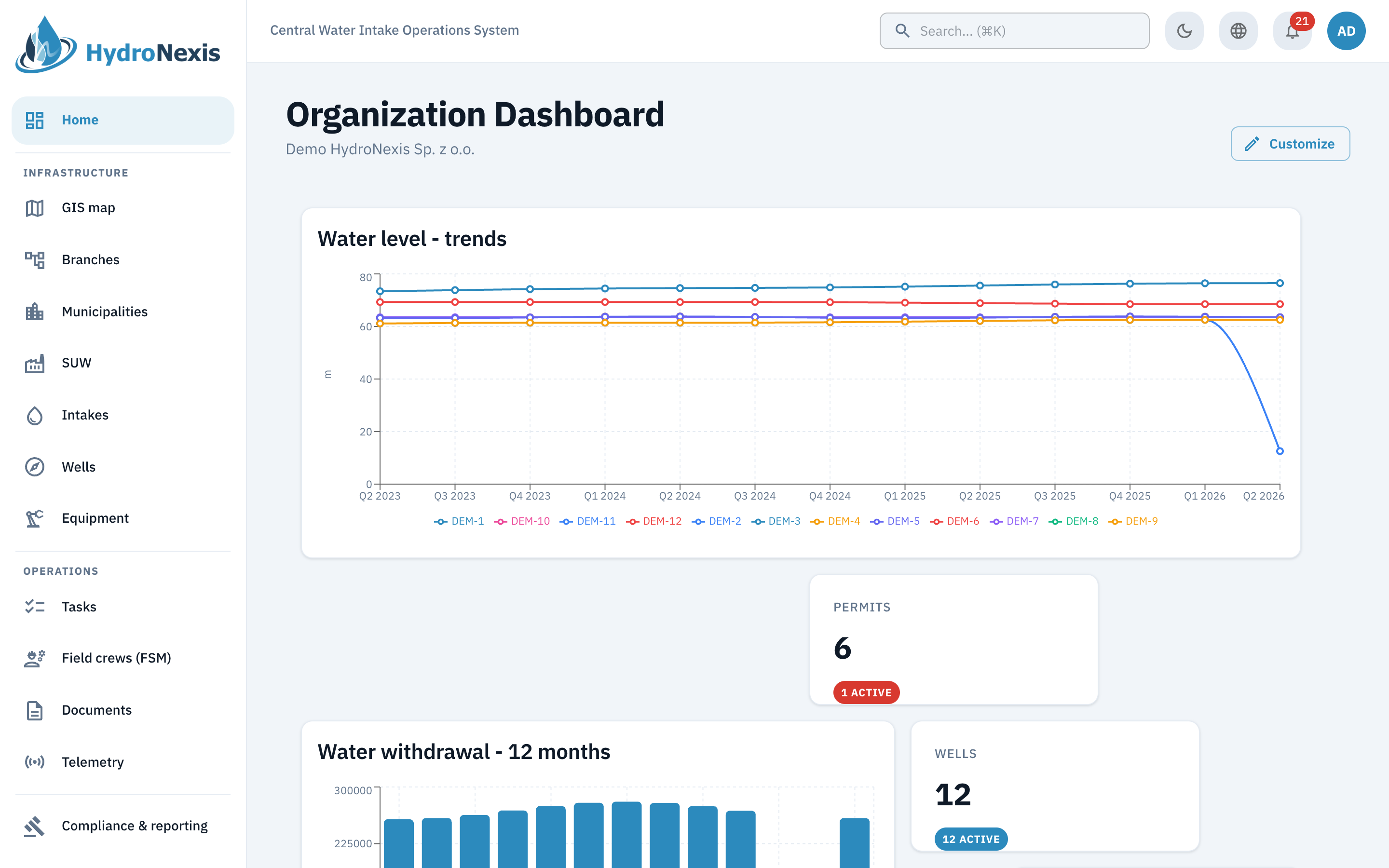
WMS - organization dashboard
Organization dashboard

A configurable dashboard with the state of the enterprise: water level trends, the number of permits and wells, and water abstraction over 12 months. The most important indicators on one screen.

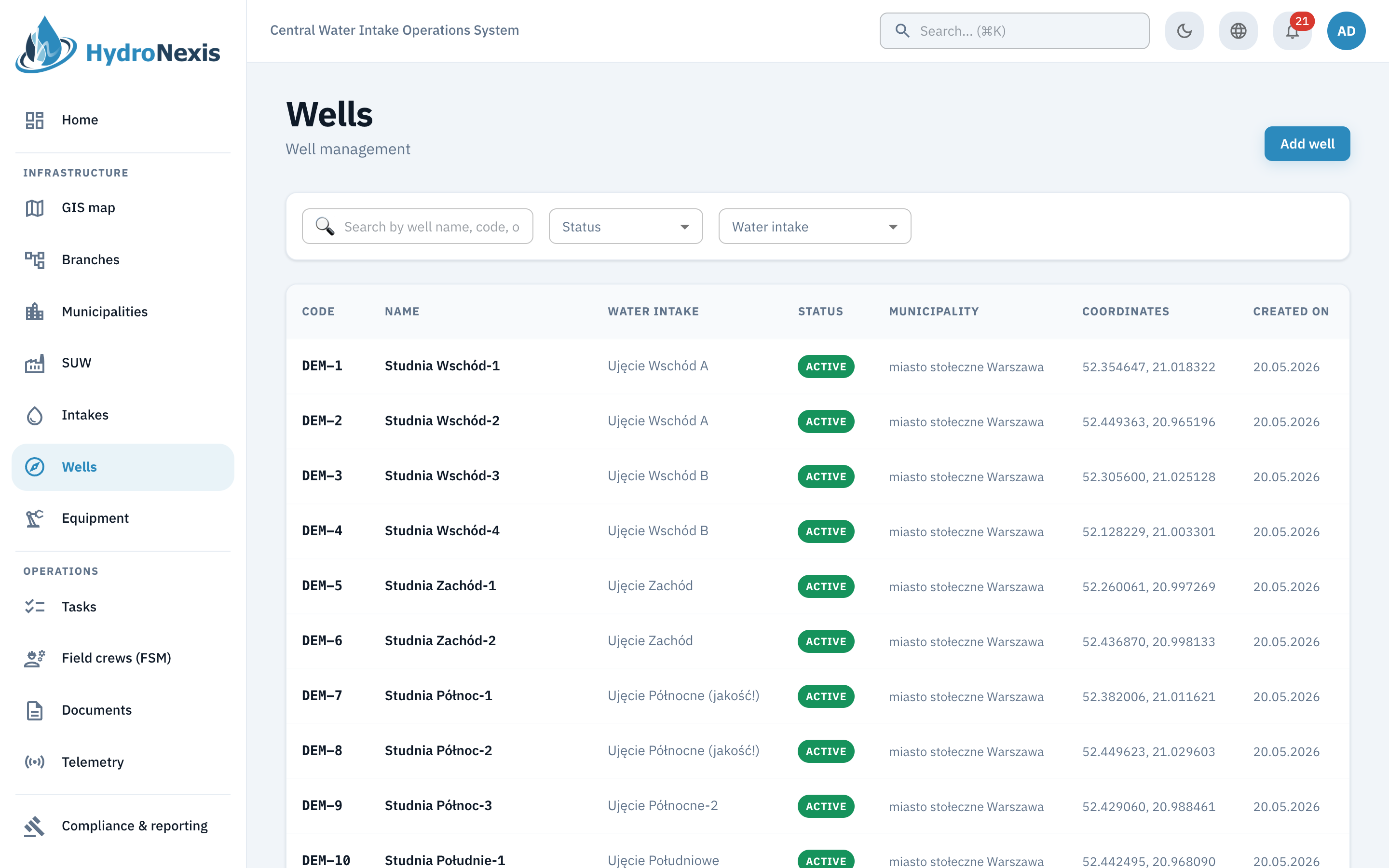
WMS - well register
Well register

A well register with code, name, assigned intake, status, commune and coordinates. Filtering and search across the entire asset base - the foundation of the digital operation log.

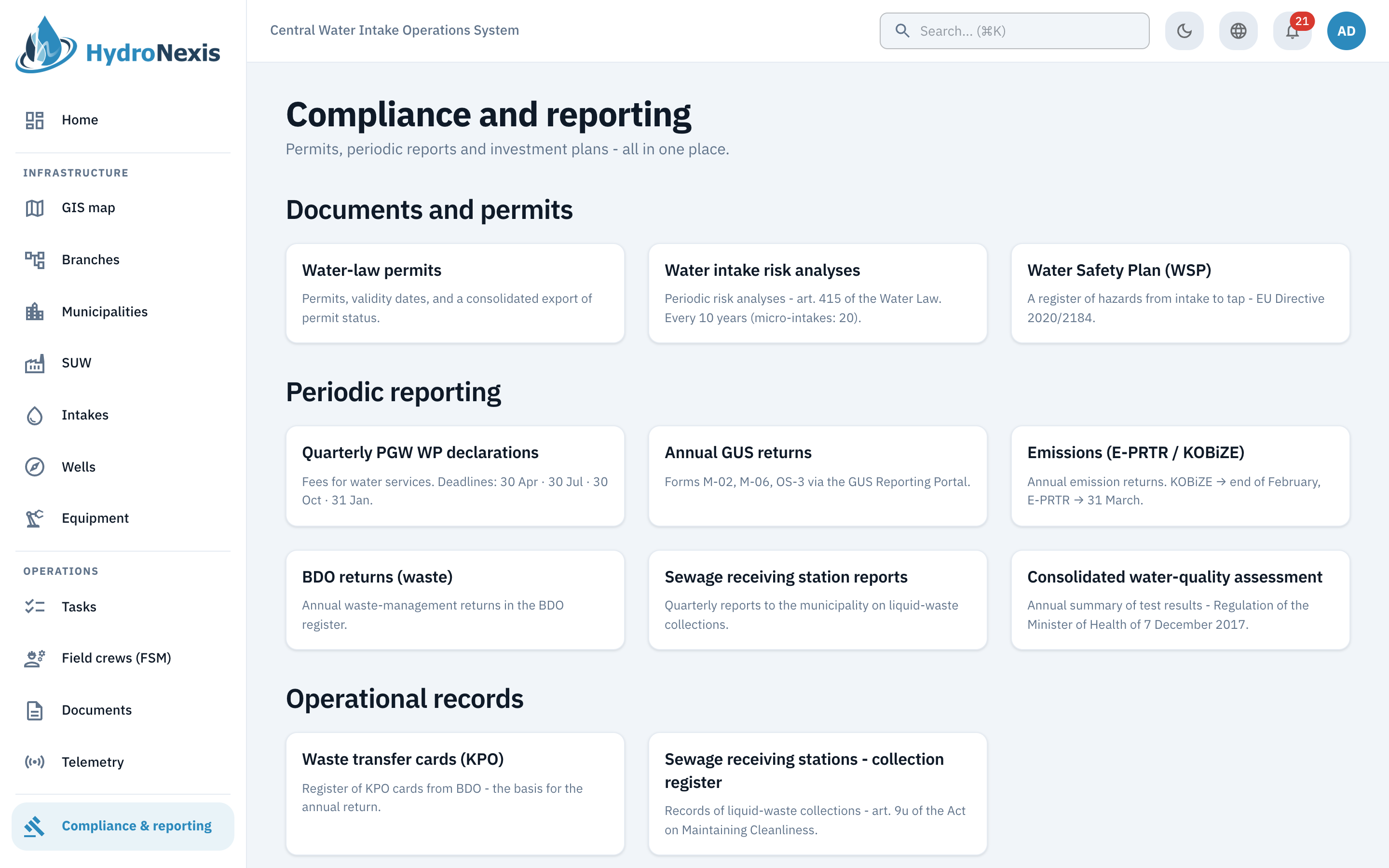
WMS - compliance and reporting
Compliance and reporting

Water permits, risk assessments and water safety plans, plus periodic reports: PGW declarations, GUS reports, BDO and emissions (KOBiZE/E-PRTR) - in one place, with deadline tracking.

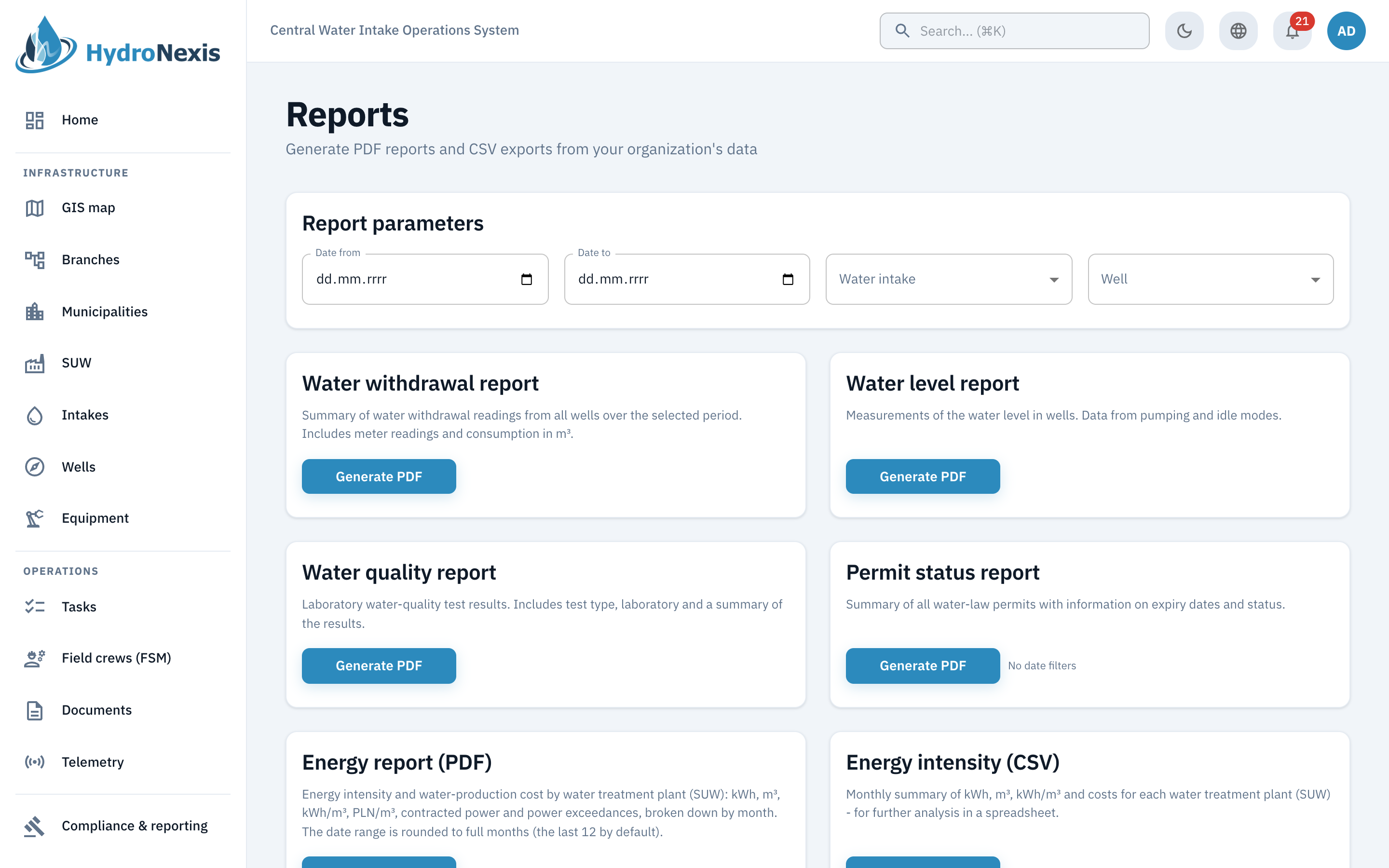
WMS - reports and exports
Reports and exports

Ready-made PDF reports and CSV exports: water abstraction, water level, water quality, permit status, and energy and energy intensity - with filters by date, intake and well.

Integrations

WMS works with official systems to reduce manual work and ensure compliance.

GUS / REGON registry

When registering an organization, the system automatically retrieves the company name and address from the official registry using its tax (NIP) or court-registry (KRS) number. Faster and error-free.

KSeF - e-invoices

Energy invoices can arrive automatically from the National e-Invoicing System (KSeF). Compliance with the e-invoicing obligation without manually entering bills.

Document reading (AI)

The AI engine reads uploaded decisions, passports, invoices and test results and prepares initial drafts. Automation of data entry and archive migration.

Control

Telemetry readings from the Control module (level, flow, power) available directly in the well card - remote supervision without a site visit.

GIS map module

A spatial view of your entire infrastructure based on the coordinates of branches, stations, intakes and wells.

Field application (FSM)

A single login connects the office with the field - data on infrastructure and permits feeds crew work orders, without double entry.

What your team gains

Time savings

AI pre-fills records, and reports are built from operational data. Instead of re-typing - you approve.

Legal security

A dozen or so types of deadlines tracked in the background protect you against the most costly violations.

Cost control

PLN/m³ and kWh/m³ indicators show where energy is used inefficiently - and where to save.

Data-driven decisions

A configurable dashboard, KPIs and forecasts give management a concise picture of the enterprise.

Frequently Asked Questions

The system is ready for immediate use. After ordering a demo and determining the scope of cooperation, we activate your organization's account within 1-3 business days. Your team can start using the platform right away - the import of existing data (technical documentation, measurement history, water permits) and training are carried out in parallel, in the first 1-2 weeks. We adjust the scope of data import to the scale of your infrastructure.

You upload any document - a water permit decision, a well passport, an energy invoice or a test result. The AI engine reads its content and prepares an initial record draft with a marked confidence level. Nothing enters the system automatically: an employee verifies and approves the data. This radically speeds up data entry and the migration of paper archives, without losing control over their accuracy.

WMS integrates natively with the Control module, which is our telemetry and monitoring system - without additional configuration. For external telemetry systems, we work with industrial protocols (Modbus, OPC UA, MQTT) and integrations via REST API. We determine the specific scope of integration during the implementation conversation - depending on the measuring devices and existing infrastructure.

WMS manages obligations towards Polish Waters (Wody Polskie), the national statistical office (GUS), the public health authority (Sanepid/PIS) and BDO, as well as emission reports (KOBiZE/E-PRTR) and wastewater reports. It covers, among others, water-charge declarations, GUS statistical reports, waste transfer notes (BDO/KPO), the register of delivered wastewater and the annual aggregate water quality assessment. Forms are pre-filled with operational data, run through a full workflow (draft → ready → submitted → confirmed) and generated to PDF. If your institution requires a specific format that we do not support by default, we prepare a dedicated template as part of the implementation.

WMS automatically monitors the validity dates of all water permits in the organization. Permits are marked with statuses: VALID (green), CRITICAL (expiration approaching, red) or EXPIRED. The number of expiring and expired permits is visible on your organization's dashboard from your first login. We activate email notifications about upcoming deadlines according to your team's preferences (typically 90, 60 and 30 days before expiration).

Yes. WMS includes a dedicated drinking-water risk assessment module, compliant with EU Directive 2020/2184 (mandatory from 2026), covering three layers: the intake catchment area, the supply system and internal installations in priority premises. The module lets you prepare input data, exchange packages with an external assessor, import a completed assessment and maintain registers of risk control measures, the monitoring schedule and corrective actions. A new legal requirement becomes a managed, timely process.

By default, we deliver WMS in the cloud model (SaaS) - data is hosted in the cloud on servers located in the European Union, in accordance with GDPR requirements. We use connection encryption (HTTPS), data encryption at rest and automatic backups.

For customers whose security policy requires keeping data in their own infrastructure (typical for some municipal water utilities and industrial enterprises), we offer on-premise implementation - a full installation of WMS on the customer's servers. Both options run the same software and have identical functionality. The difference concerns only the place of data storage, the billing model and the scope of responsibility for maintaining the infrastructure.

The data of each enterprise is separated from one another, and access is protected by login with optional two-factor authentication. We determine the choice of model during the implementation conversation - depending on your security policy, your server infrastructure and internal requirements.
WMS is billed in the SaaS model - a monthly or annual subscription, with no license costs or infrastructure investment on the customer's side. Pricing is individual, based on the scale of the infrastructure (number of intakes and wells), the number of users and the scope of integration with existing systems. As standard, the contract includes technical support, updates and hosting. In the on-premise model, we bill the license and technical support separately. We prepare a specific offer after a short conversation about your needs.

Yes. Just fill out the Request a Demo form - we will contact you within 24 hours and arrange a 30-45 minute presentation tailored to your infrastructure. No obligations and no cost.

Request a Demo WMS

30-45 minutes of presentation tailored to your intakes. No strings attached.

+48 505 901 805